

Project team
Project leader: Lilla Mate-Kovacs
Co-investigators: Sarah Ashcroft-Jones, Kai Ruggeri
The wider authorship list includes the following consortium:
Justus Schmidt, Sandra J Geiger, Max Accurso, Notavious Luis Andino-Galarza, Jawad Asaria, Marija Bajčetić, Yassin Bassem, Aljaž Bogolin, Lidia Borkovic, Lukas Robert Braun, Lindsey M Brown, Hana Cohen, Margot Delany, Xiaoyu Deng, Zsolt Tamás Devecser, Mariam Elmais, Eman Farahat, Darianna Frontera-Villanueva, Andrea Lorenzo Gallicchio, Madeline Galloway, Albaraa Gebril, Milena Guimaraes, Anja Heske, Neža Hrovat, Nurlana Ismayilzada, Ye-Ji Kim, Natália Kocsel, Anikó Kövér, Oscar Manuel Landa Samano, Shawna Lane, Elena Manchorova, Anja Maršič, Dorina Matyi, Jana Mészarosová, Rade Milaković, Tina Nguyen, Hannah Daniela Obertautsch, Georgia Petridou, Owen Puhl, Kayla D Russell, Christian Stephens, Catherine Lily Thomas, Valeria Tutinelli, Guillermo Valenzuela-Catarí, Mirella Wojciechowska, Yuki Yamada, Csilla Ágoston, Ágnes Buvár, Attila Varga, Gyöngyi Kökönyei.
Project status
Ongoing
Project dates
2025-2026 (peer review process ongoing), most work carried out August/September 2025
Funding
This study was supported by the Hungarian National Research, Development and Innovation Office (K143764, ADVANCED 150815). Lilla Nóra Kovács and Natália Kocsel were supported by the EKÖP-25 University Research Scholarship Program of the Ministry for Culture and Innovation from the Source of the National Research, Development and Innovation Fund (Grant Numbers: EKÖP-25-4-II-ELTE-693; EKÖP-25-4-II-ELTE-845 respectively). Albaraa Gebril and Landa Samano Oscar Manuel received support from the Columbia University Center for Global Engagement (Global Learning Scholarship). Elena Manchorova was supported by the Academic Opportunity Fund and Keasbey Grants from University College, Oxford. Christian Stephens was supported by the Randall Research Scholars Program in the University of Alabama Honors College, through the Chenault Research Support Grant. Gyöngyi Kökönyei was supported by the Hungarian Brain Research Program (NAP2022-I-4/2022), and by and the Ministry of Innovation and Technology of Hungary from the Hungarian National Research, Development and Innovation Fund (TKP2021-EGA-25).
Overview
The Policy Research Group
The Policy Research Group has one simple view: appropriate use of evidence in policies will benefit population outcomes. To demonstrate this, the team works on a series of projects across many domains of interest to psychologists, policymakers, and industry. In each case, they look for the best way to carry out high quality research that retains real-life value.
As work is carried out, PRG constantly aims to translate insights into meaningful outputs, engaging with stakeholders and champions throughout.
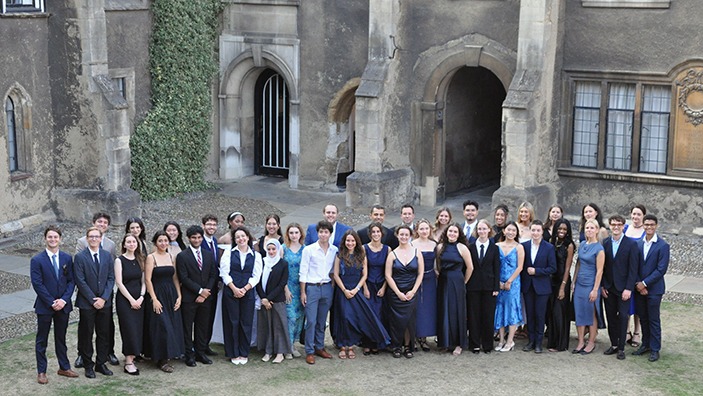
The main members of the Policy Research Group, with their fellow researchers and co-authors.
The ultimate goal within PRG is to generate relevant evidence for decision-making, whether informing leaders about complex challenges or simply engaging individuals with research outcomes in a way that speaks to the widest possible audience. In reaching for this goal, the research group hopes to offer improved outcomes for populations, particularly regarding their security, economic stability, and well-being.
The PRG is a small team of researchers and affiliates within the CBR that are focused specifically on behavioural insights in policy, particularly in linking experimental methods to real-world applications. Our primary contribution in CBR has been through the GCRF Research for Health in Conflict (R4HC-MENA) project, with a handful of additional projects related to behaviour and decision-making.
Background
Every day, large online platforms determine what millions of people see and influence how users interact with the platforms and each other. Platforms wield this power through online choice architecture – that is, the online environments in which people make decisions (Thaler et al, 2013). Online choice architectures can be empowering: they can offer users a far greater range of products and information sources to select from than any one shop or library can carry, as well as targeted suggestions through recommender systems and algorithms. But online choice architectures can also lead people toward choices that might not be in line with their goals, such as sharing misinformation, overpurchasing and doom scrolling, thus threatening individuals’ control over their decisions (Kozyreva et al, 2020).
Aims and objectives
We aim to use a text based experimental manipulation to test the effectiveness of gain- and loss-framed communication about climate change across a broad and diverse international sample, including respondents from 26 countries (n = 11,934).
Methods
To test our predictions, we conducted a large-scale, preregistered online experiment with a convenience sample across 26 countries. We first assessed baseline climate emotions, perceived severity of climate change, and information-seeking intention. We then randomly assigned participants to read either a loss- or gain-framed climate change message. We assessed their current level of climate emotions, perceived severity of climate change, information-seeking intention, and actual information-seeking behaviour (ie link-clicking).
Progress
The manuscript is complete and has been under peer review since December 2025, it was recently rejected after extensive but largely positive review from Nature Communications, and is currently being resubmitted to Nature Human Behaviour.